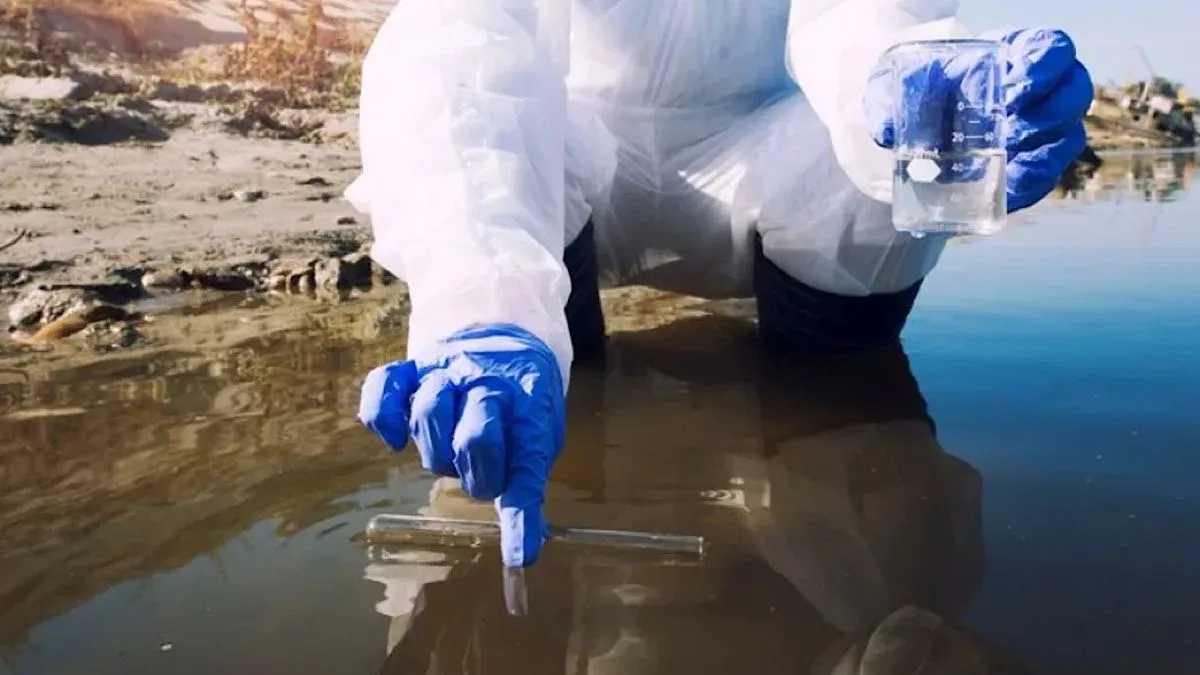
Researchers from the Indian Institute of Technology (Banaras Hindu University) and Parul University have developed an innovative and environmentally friendly technology to remove the highly toxic and carcinogenic dye “malachite green” from industrial wastewater.
This research is considered a significant achievement towards addressing the serious environmental challenge posed by industrial water pollution.
Advertisement
This joint research was conducted by the School of Biochemical Engineering at IIT-BHU and the Department of Chemical Engineering at Parul Institute of Technology, Parul University, Vadodara.
The research team included Dr. Vishal Mishra, Associate Professor at the School of Biochemical Engineering at IIT-BHU, along with Mr. Alok Tiwari, Gaurang Damle, Dr. Shivendu Saxena, Dr. Vishal Sandhwar, Ms. Diksha Saxena, and Dr. Deepak Jadhav from JSPM University, Pune.
Researchers developed this novel nanocomposite using orange peel (Citrus sinensis) extract as a natural reducing agent, making the technology completely environmentally friendly and waste-based. It involves developing a co-polymerized layer of polyaniline and polypyrrole on tin oxide nanoparticles using in-situ polymerization.
Key features of the technology include the use of renewable and zero-cost waste materials like orange peels, the ability to remove 97.06% of malachite green dye in just 30 minutes, and the absence of expensive equipment, hazardous chemicals, or trained labor.
The technology is non-toxic, biocompatible, and easily scalable for industrial use.
Dyed wastewater from industrial units worldwide is considered a serious environmental threat. Malachite green is a particularly toxic, carcinogenic, and non-biodegradable chemical that poses a significant risk to aquatic life and human health.
Expressing his delight at this achievement, IIT-BHU Director Prof. Amit Patra congratulated the researchers and said here on Monday that this type of collaborative and applied research demonstrates the institute’s commitment to sustainable technology development to address societal and environmental challenges. He stated that IIT-BHU will continue to foster innovations that are socially beneficial and have global impact.
Dr. Vishal Mishra stated that this joint research is an excellent example of the strong academic and research collaboration between IIT-BHU and Parul University. He explained that a practical and cost-effective solution for industrial wastewater treatment has been developed by combining biochemical engineering and advanced materials science. The researchers stated that future work will be done to reuse this technology and test it in real industrial wastewater systems.